
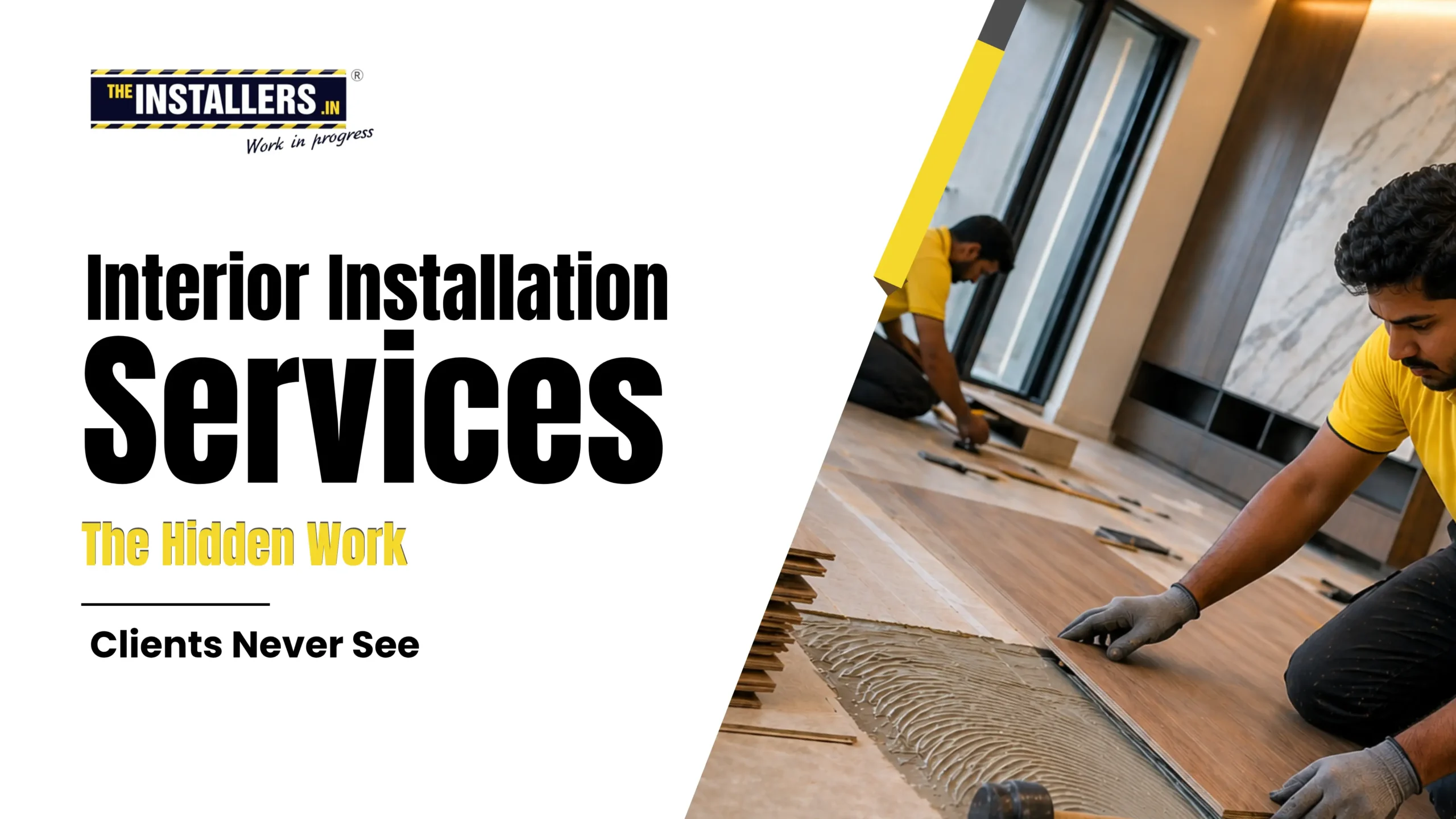

Interior installation is where a project truly comes to life, but it is also where most mistakes quietly begin.
After decades of working on sites across different types of homes and projects, one thing becomes very clear. Clients usually focus on what they see at the end. Smooth flooring, perfectly aligned wallpaper, sharp edges, and clean finishes. Everything looks complete, and naturally, the attention goes to design and materials.
But the truth is very different.
What makes an interior last is not the finish you see. It is the work that happens before and during installation.
That is the part most people never notice, yet it decides whether the space performs well for years or starts showing problems within months.
Most people assume installation is just the final step. Something that happens quickly once everything else is ready.
In reality, installation is the most critical phase of the entire project.
You can have the best materials, premium brands, and a well-planned design. But if installation is not done correctly, the result will not hold.
I have seen high-budget interiors begin to fail within a short time, not because the materials were poor, but because the execution lacked process and precision.
Installation is not finishing work. It is technical work that requires understanding, discipline, and experience.
The first stage, and the one most commonly ignored, is surface preparation.
Before anything is installed, the base must be correct.
On real sites, what we often encounter is:
- Uneven wall surfaces
- Dust and debris left from civil work
- Moisture still present in walls or floors
- Incomplete curing of plaster or concrete
If installation starts under these conditions, problems are not a possibility, they are a certainty.
Adhesives will not bond properly. Materials will not sit evenly. Over time, gaps, bubbles, and surface failures begin to appear.
Clients rarely see this stage because it happens before the visible work begins. But this is where the strength of the entire installation is decided.
If the base is wrong, everything built on it will eventually fail.
Measurement and planning are the next steps that separate average work from professional work.
Good installation does not begin with tools. It begins with understanding the space.
This involves:
- Accurate measurements
- Layout planning
- Deciding how materials will align and where joints will fall
This is especially important in flooring, wallpaper, and panel installations.
If planning is rushed or ignored:
- Patterns will not align properly
- Joints will become visible
- Material wastage increases
What appears simple from the outside is actually a calculated process.
Material handling is another area where experience plays a major role.
Every material behaves differently.
Wood reacts to moisture and expands or contracts. Vinyl responds to temperature changes. Wallpaper can stretch or tear if not handled correctly.
Improper handling leads to:
- Gaps in flooring
- Bubbles in vinyl
- Wrinkles in wallpaper
In many cases, people assume the material is defective.
But in reality, the problem often begins at the installation stage.
Experience teaches how to handle each material correctly under different site conditions.
Another critical aspect is the use of adhesives and fixing methods.
There is no universal solution.
Different materials require different approaches:
- Some need strong bonding adhesives
- Some require flexible adhesives
- Some installations need mechanical fixing instead of adhesive
However, what happens on many sites is predictable.
The same adhesive or method is used everywhere to save time and effort.
This might make the work faster, but it reduces durability.
The method used to fix a material is what determines how long it will last.
Alignment and precision are what define the final experience of a space.
When installation is done correctly, everything feels natural.
Floors are level. Patterns flow seamlessly. Edges are sharp and clean.
When it is done poorly, the issues may not be immediately obvious, but they become noticeable with time.
You begin to see:
- Uneven levels
- Misaligned patterns
- Visible joints
These are not minor issues. They affect how the entire space feels.
And once the work is completed, correcting these problems becomes difficult and expensive.
Time pressure is one of the biggest reasons installation quality suffers.
Many projects are driven by deadlines.
Clients want quick results. Contractors promise faster completion.
But installation does not respond well to speed.
When work is rushed:
- Surface preparation is skipped
- Measurements are taken casually
- Finishing is compromised
I have seen projects that looked perfect on the day of completion but started showing defects within a few months.
Good installation requires time. Rushed installation creates future problems.
There are also areas in every project that clients rarely inspect but should.
These include:
- Corners and edges
- Joints between materials
- Areas near ceilings
- Sections around switches and fittings
These are the points where shortcuts become visible.
A professional installer pays close attention to these areas because they understand that quality is revealed in details.
One of the most common mistakes clients make is reducing the budget for installation.
They invest heavily in materials and design but try to save on execution.
This decision often leads to:
- Poor workmanship
- Early failures
- Repair costs
- Complete reinstallation
In most cases, the money saved initially is spent later in fixing problems.
Saving on installation is one of the most expensive compromises in any project.
A professional installation approach is different.
It is not just about completing the work. It is about managing the process from start to finish.
An experienced installer will:
- Inspect the site before starting
- Identify potential issues
- Prepare surfaces properly
- Choose the right tools and materials
- Focus on finishing details
- Ensure long-term performance
More importantly, they take responsibility for the final outcome.
The difference between good and poor installation is not visible immediately.
On the first day, most work looks acceptable.
But the real difference shows over time.
After a few months:
- Good installation remains stable
- Poor installation begins to show defects
After a year:
- Good work continues to perform
- Poor work requires repairs or replacement
That is the true measure of quality.
Interior installation is not just about placing materials into a space.
It is about understanding the surface, the environment, and the behavior of materials.
It is about preparation, precision, and process.
What clients see at the end is only a small part of the work.
The real effort lies in everything that happens before and during installation.
After years of experience, one thing remains consistent.
Clients remember how a space looks.
But they live with how it performs.
And performance depends entirely on installation.
Good installation stays invisible because everything works.
Bad installation becomes visible because everything starts failing.