
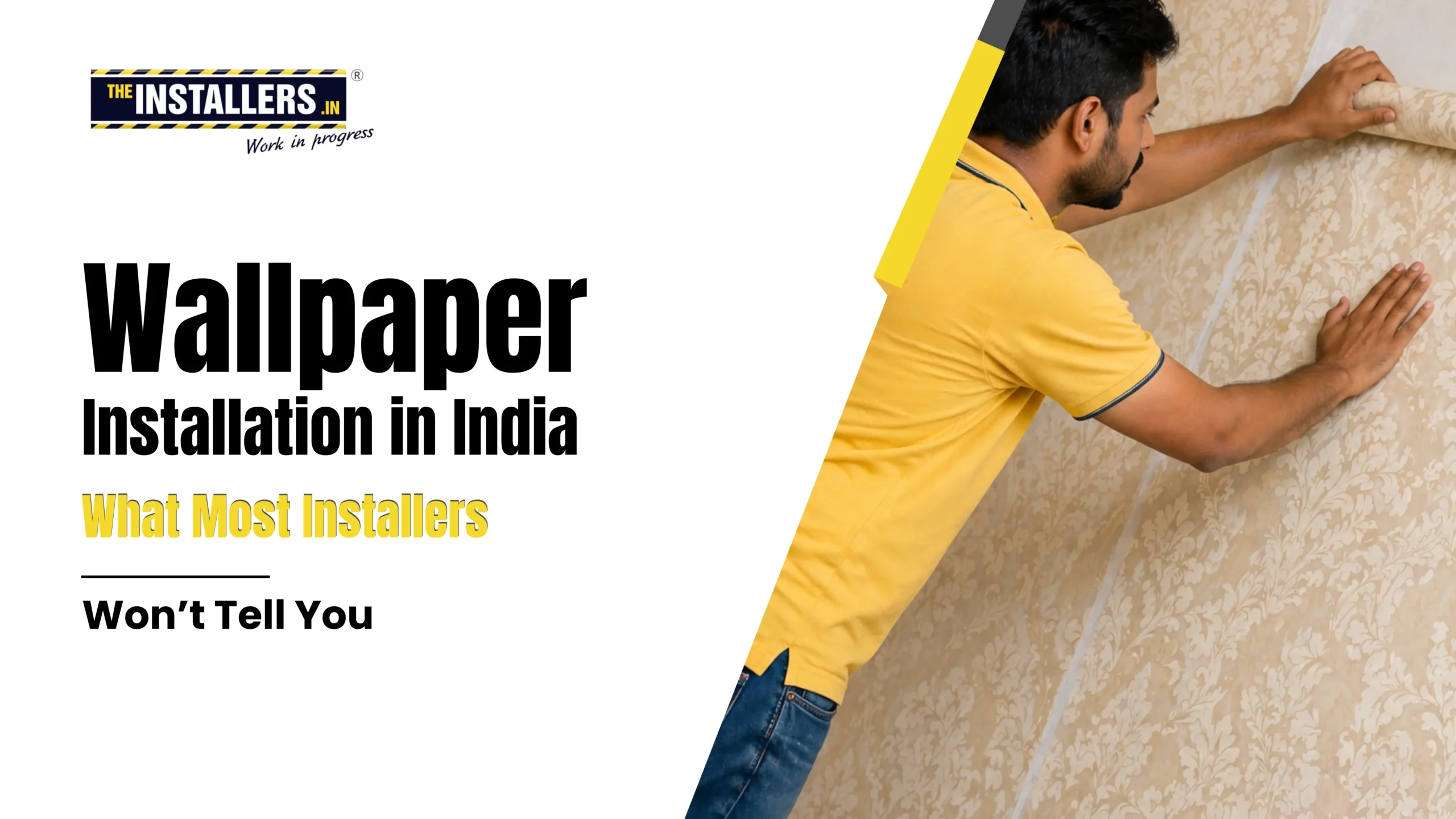

Wallpaper Installation is the Illusion of a Perfect Wall
Wallpaper has made a strong comeback in Indian homes. From compact apartments to premium villas, it is now seen as a quick way to add personality to a space.
On day one, it looks flawless.
Smooth finish. Perfect alignment. Clean edges.
But here’s the part most people only discover later:
Wallpaper doesn’t fail immediately. It fails gradually.
What starts as a minor imperfection becomes a visible issue over time:
- A corner that slightly lifts
- A seam that becomes noticeable
- A small bubble that spreads
- A patch that begins to discolor
And by the time it becomes obvious, the damage is already done.
In most cases, the problem is not the wallpaper.
It is the installation process that was rushed, simplified, or misunderstood.
Why Wallpaper Installation Is Often Underestimated
In India, wallpaper installation is still treated as a “finishing job.” Something quick. Something secondary.
That assumption is where the trouble begins.
Because wallpaper installation is not decorative work—it is technical surface work.
It demands:
- Understanding of wall conditions
- Control over moisture and surface stability
- Precision in alignment
- Knowledge of materials and adhesives
Most issues arise not because installers don’t work hard—but because they don’t follow a structured process.
And in this field, process is everything.
The Wall Beneath the Wallpaper
Let’s begin with what most homeowners never see—the wall itself.
In many Indian homes, walls are rarely perfect. Even in new constructions, you’ll often find:
- Minor undulations
- Hairline cracks
- Uneven plastering
- Residual moisture
- Layers of previous paint
Now here’s the reality:
Wallpaper does not hide imperfections. It amplifies them.
A slightly uneven wall becomes more noticeable once wallpaper is applied.
A small crack can eventually show through the surface.
That’s why preparation matters more than installation.
A properly prepared wall should be:
- Smooth and level
- Completely dry
- Free from dust and grease
- Primed for adhesion
Skipping this step is the most common reason wallpaper fails.
Moisture: The Problem That Shows Up Late
If there is one factor that consistently causes wallpaper failure in India, it is moisture.
And the problem with moisture is simple—it is not always visible.
It may come from:
- Newly plastered walls
- External seepage
- Bathrooms on adjacent walls
- Humid weather conditions
When wallpaper is installed over a damp surface:
- Adhesive bonding weakens
- Air pockets begin to form
- Edges start lifting
- Mold or discoloration may develop underneath
What makes this worse is timing.
Moisture damage doesn’t show up in the first week.
It appears slowly—often after the installer has left and responsibility becomes unclear.
Adhesives: The Most Misused Element in Installation
Ask most people about wallpaper, and they’ll talk about design, texture, or brand.
Rarely does anyone talk about adhesive.
Yet, adhesive is what holds everything together.
Different wallpapers require different types of adhesives:
- Vinyl wallpapers need stronger bonding agents
- Fabric-backed wallpapers require controlled application
- Heavy textured wallpapers need thicker adhesive layers
In many low-cost installations, a single generic adhesive is used for all types.
Why?
Because it’s cheaper.
Because it’s faster.
Because it’s convenient.
But the result is predictable:
- Weak bonding
- Peeling edges
- Reduced lifespan
A professional installer adjusts adhesive type and application method based on the material.
That’s where experience shows.
Pattern Matching: The Detail That Separates Average from Expert
Wallpaper is not just about covering a wall—it’s about creating continuity.
Patterns must align seamlessly across strips.
This requires:
- Careful measurement
- Consistent placement
- Patience during application
When done correctly, you don’t notice the joints.
When done poorly:
- Patterns break
- Lines shift
- The design feels disjointed
And once installed, this cannot be corrected without redoing the entire section.
This is not a place for shortcuts.
Edges, Corners, and Cutouts: Where Reality Shows
If you want to judge the quality of wallpaper installation, don’t look at the center of the wall.
Look at:
- Corners
- Ceiling edges
- Switchboard cutouts
- Window borders
These are the most difficult areas to execute.
This is also where poor workmanship becomes visible:
- Rough cuts
- Lifting edges
- Uneven finishing
A professional installer spends extra time here.
Because they know one thing:
Clients may not notice perfection—but they will always notice flaws.
Time Pressure: The Hidden Enemy of Quality
Many installations are rushed.
Clients want quick completion.
Contractors promise fast delivery.
Installers are pushed to finish multiple sites.
But wallpaper installation does not respond well to speed.
Each step requires time:
- Wall preparation
- Adhesive setting
- Alignment adjustments
Rushing leads to:
- Improper bonding
- Misalignment
- Reduced durability
Good installation is not slow—but it is never rushed.
The Cost Myth That Misleads Most Homeowners
One of the most common decisions homeowners make is choosing the lowest installation quote.
It feels logical.
But let’s look at what actually happens.
Initial saving:
- A few thousand rupees on installation
Later costs:
- Repair attempts
- Partial replacement
- Full reinstallation
Add to that:
- Time lost
- Inconvenience
- Frustration
In most real scenarios, the final expense becomes significantly higher than the original saving.
Cheap installation is rarely cheap in the long run.
What Professional Wallpaper Installation Really Looks Like
A professional installation is not defined by speed or price.
It is defined by process and consistency.
Here’s what you’ll notice with experienced installers:
- They inspect walls before giving a quote
- They highlight potential issues upfront
- They prepare surfaces properly
- They use appropriate adhesives
- They focus on alignment and finishing
- They review the work before completion
More importantly, they don’t rush.
Because they understand that once wallpaper is installed, correction is not easy.
Choosing the Right Installer: What Actually Matters
Most homeowners focus on:
- Price
- Availability
- Timeline
But the right installer is identified differently.
Look for someone who:
- Asks about wall condition, not just size
- Talks about preparation, not just installation
- Explains material handling
- Sets realistic expectations
- Is willing to say “this wall needs work before installation”
That last point matters.
An installer who points out problems is more reliable than one who ignores them.
The Difference You Only Notice Later
On day one, most wallpaper installations look acceptable.
But the real difference appears over time.
After 3–6 months:
- Good installation remains stable
- Poor installation begins to show issues
After a year:
- Good installation still looks clean
- Poor installation often needs repair or replacement
That is the true measure of quality.
Final Reflection from the Field
Wallpaper is one of the most expressive elements in a home.
It adds character instantly.
But it is also unforgiving.
It does not hide mistakes.
It reveals them—slowly, but clearly.
And after years of working across different homes, climates, and conditions, one truth stands firm:
The success of wallpaper is not decided by design.
It is decided by installation.
Conclusion: What You See Depends on What Was Done Before
When you look at a finished wallpaper wall, you see design, color, and texture.
What you don’t see is:
- The preparation beneath
- The care during installation
- The decisions made at every step
That unseen work defines the outcome.
So if you’re planning wallpaper, don’t just focus on how it looks today.
Think about how it will perform tomorrow.
Because in the end:Good installation disappears into the wall.
Bad installation stays with you.