
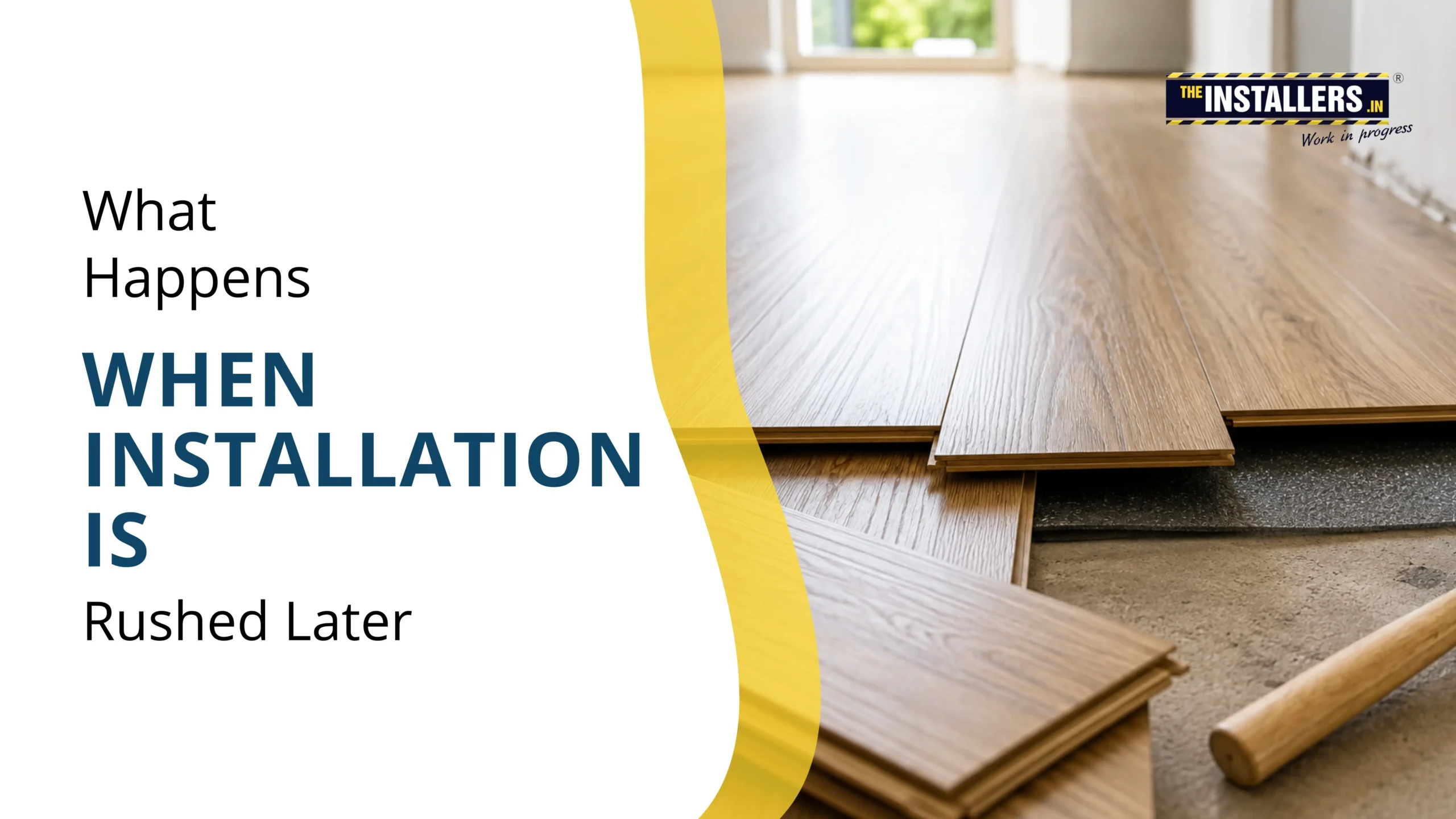

What Happens When Installation Is Rushed usually becomes visible after the project is already complete. That is what makes rushed work dangerous. On handover day, everything often appears acceptable. The flooring looks level, the wallpaper feels smooth, and the wall panels seem perfectly aligned.
Then slowly, the problems begin.
A corner starts lifting. A flooring joint opens slightly. Adhesives weaken. Wallpaper edges peel. Small imperfections become visible one after another.
And after decades in the installation industry, one thing remains consistently true:
Rushed installation always leaves evidence behind.
The frustrating part is that most homeowners only realise this after they start living with the space.
Why Modern Interior Projects Are Constantly Being Rushed
Interior projects move faster today than ever before.
Clients want quick completion because they are eager to move into their homes or open commercial spaces on schedule. Contractors compete on timelines because faster delivery attracts attention.
Unfortunately, installation quality becomes the first sacrifice when deadlines become unrealistic.
Most people think installation simply means fixing materials into place. In reality, professional installation involves:
- Surface preparation
- Measurement planning
- Material conditioning
- Adhesive curing time
- Precision alignment
- Finishing detail work
Each stage requires time.
When projects are rushed:
- Preparation becomes incomplete
- Adhesives are forced too early
- Finishing details get ignored
- Measurements become less accurate
At first glance, these shortcuts remain hidden.
But over time, materials begin reacting to those mistakes.
Installation failures rarely happen immediately. They develop slowly through daily use, moisture changes, movement, and pressure on the surfaces.
From experience, flooring and wallpaper installations expose rushed workmanship faster than most other interior services. The problems may start small, but they rarely stay small for long.
Surface Preparation Gets Ignored Before Anything Else
Every experienced installer understands one basic truth.
The finish is only as strong as the surface underneath it.
Yet this is the exact stage that rushed projects skip first.
On real sites, walls and floors are rarely fully ready when installation begins. We consistently encounter:
- Uneven flooring levels
- Dust left from civil work
- Damp surfaces
- Improper curing
- Hairline cracks hidden under paint or plaster
Correcting these issues takes time, which rushed timelines do not allow.
So instead of fixing the surface properly, installation begins immediately.
Initially, the result may still look acceptable.
Then slowly:
- Flooring begins sounding hollow
- Wallpaper starts peeling near edges
- Adhesive bonding weakens
- Panels shift slightly out of alignment
In practice, what we consistently see is that most long-term installation failures begin underneath the visible surface.
Clients often assume the material was defective because that is the only part they can see.
But materials cannot perform correctly when the foundation underneath them is weak.
Poor Measurements Create Problems That Stay for Years
Professional installation depends heavily on planning.
Before flooring planks, wall panels, or wallpaper rolls are installed, experienced installers calculate:
- Material direction
- Joint positioning
- Expansion allowances
- Pattern alignment
- Finishing around edges and corners
These details may sound small, but they completely affect how a finished space feels.
Rushed projects remove this planning stage because proper layout preparation takes time.
Measurements become approximate instead of precise.
The result appears later:
- Flooring lines look uneven
- Wallpaper patterns fail to align naturally
- Panel spacing becomes inconsistent
- Corners look awkward
Most homeowners cannot identify the technical reason behind these issues, but they immediately notice that something feels “off” visually.
Good installation creates balance. Rushed installation creates distraction.
From experience, corners and edge finishes reveal installation quality faster than large open surfaces. That is where shortcuts almost always become visible first.
And unlike paint touch-ups, installation corrections usually require partial removal and rework.
Adhesives Need Time to Perform Properly
One of the most misunderstood parts of interior installation is adhesive behavior.
Different materials require different bonding systems. Some adhesives require flexibility. Others require longer curing times depending on temperature, humidity, and surface conditions.
Rushed projects ignore these realities.
What commonly happens:
- Flooring is walked on too early
- Wallpaper is installed on walls that are not fully dry
- Panels are fixed before adhesives settle properly
- Heavy furniture is placed before bonding stabilises
Initially, the installation may still appear stable.
Then gradually:
- Corners begin separating
- Surfaces shift slightly
- Edges start lifting
- Adhesives lose strength
Clients often blame the product itself.
But after years in this field, one thing becomes obvious:
Most adhesive failures are actually timeline failures.
Materials need time to settle properly.
That requirement has not changed regardless of how advanced modern installation products become.
Finishing Quality Always Drops Under Time Pressure
Professional installation is revealed in the details.
Not in the centre of the room.
In the finishing.
Corners, ceiling edges, switch cut-outs, panel joints, and flooring transitions require patience and concentration.
And patience disappears the moment installation becomes rushed.
This is why fast projects often develop:
- Rough edge cuts
- Uneven joints
- Poor alignment around fittings
- Visible gaps near transitions
At first, clients may not notice these details because the overall space still feels fresh and new.
But daily use slowly exposes every shortcut.
In practice, what we consistently see is that rushed finishing causes interiors to lose their premium feel much faster than expected.
Even expensive materials begin looking average when finishing quality drops.
The difference between average installation and professional installation is usually hidden inside the details.
Worker Fatigue Quietly Affects Installation Quality
This is something most homeowners never consider.
Installation is precision work. Precision requires focus.
But rushed timelines create physical and mental fatigue on site.
When installers work continuously under unrealistic schedules:
- Measurement accuracy decreases
- Material handling becomes careless
- Adhesive application becomes inconsistent
- Finishing mistakes increase
Even experienced installers struggle under constant pressure.
After decades of managing projects, one thing becomes very clear:
Installation quality drops the moment speed becomes more important than concentration.
Because unlike machines, installation work depends heavily on human judgement.
And judgement weakens when timelines become unreasonable.
Fast Completion Often Creates Expensive Repairs Later
One of the biggest misconceptions in interior work is believing faster timelines save money.
In reality, rushed installation often creates delayed costs.
What begins as a quicker project later becomes:
- Repair work
- Reinstallation labour
- Material replacement
- Ongoing maintenance visits
Flooring may require removal. Wallpaper may need complete replacement. Panels may need realignment.
And after project completion, corrections become far more expensive because materials are already integrated into the finished interior.
From experience, homeowners almost always repeat the same sentence afterward:
“We should have waited and done it properly.”
That sentence appears on projects of every budget level.
Cheap timelines usually become expensive outcomes.
Why Professional Installation Still Matters More Than Materials
Modern materials have improved significantly over the years.
Designs are better. Tools are more advanced. Products last longer when installed correctly.
But one thing has never changed.
Installation quality still decides whether interiors remain stable or slowly begin failing.
At The Installers, we approach every project with that understanding. Whether it is flooring, wallpaper, panel work, or interior finishing, long-term performance depends on preparation, patience, and correct execution. We focus on installation methods that protect the durability of the entire project, not just how the space looks on completion day. If you are planning an installation project, contact us for a free consultation.
Conclusion
What happens when installation is rushed rarely becomes obvious immediately. That is why so many people underestimate the damage shortcuts create.
The problems appear later, after the project is complete and everyday use begins.
Good installation requires preparation, accurate measurements, proper curing time, and finishing precision. Remove patience from that process, and durability disappears with it.
After decades in this industry, one lesson continues proving itself true:
Projects are not successful because they finish quickly.
They are successful because they continue performing properly years later.