
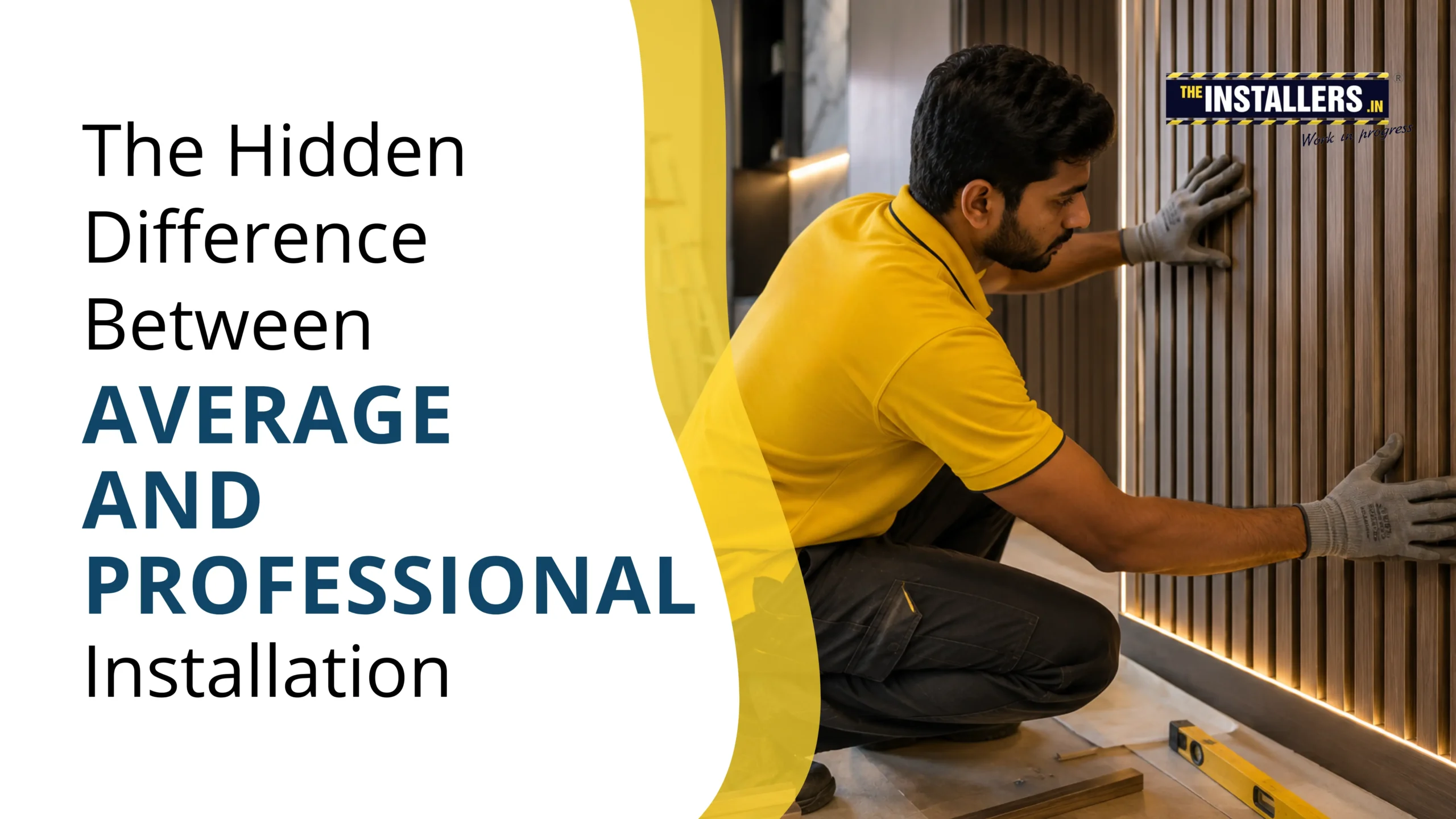

The Hidden Difference: Most people believe installation is simple.
Once the material arrives, the job is just about placing it correctly and finishing the work.
That is how installation is usually seen from the outside.
But after decades of working on real sites, I can say this clearly:
The biggest difference in any interior project is not the material. It is the quality of installation behind it.
Because average installation and professional installation may look similar on day one, but over time, the difference becomes impossible to ignore.
Clients often focus on visible things.
Design, colors, textures, brands, and finishes.
Naturally, these things matter.
But what most people do not realize is that even premium materials fail when installation is handled poorly.
I have seen expensive flooring lift within months, wallpapers start peeling, and panels lose alignment simply because the work underneath was rushed or done without proper process.
The material was never the problem.
The installation was easy.
Average installation usually focuses on speed.
The goal is to complete the work quickly and move to the next site.
Preparation becomes minimal. Measurements are rushed. Finishing details are ignored.
And in the beginning, most clients do not notice the difference.
Everything appears acceptable for a while.
But installation problems do not always appear immediately.
They show slowly.
A slight gap becomes larger. Edges begin lifting. Uneven levels become noticeable. Adhesives weaken. Finishes start losing their clean appearance.
This is how poor installation reveals itself.
Not instantly, but gradually.
Professional installation works differently.
It begins long before the visible work starts.
The first focus is always the surface.
Walls, floors, and installation areas are inspected properly because experienced installers know one important fact:
No finish can perform well on a poor base.
If the surface is uneven, dusty, damp, or improperly cured, the problem may not appear immediately, but it will eventually affect the final result.
That is why professional installation spends time on preparation instead of rushing directly into execution.
Average installation often measures only what is necessary to complete the work.
Measurement and planning are another major difference.
Professional installation studies the space completely.
This includes:
- Layout planning
- Material direction
- Pattern alignment
- Joint placement
- Edge finishing
These details may seem small, but they decide whether the installation feels clean and balanced or visually disturbed.
Good installation is rarely noticed because everything feels natural.
Poor installation constantly draws attention to mistakes.
Material handling is another area where experience matters.
Every material behaves differently.
Wood expands and contracts. Vinyl reacts to temperature. Wallpaper stretches under improper handling.
An average installer may treat all materials the same way.
A professional installer understands how each material responds to the environment and adjusts the process accordingly.
This is why professional work lasts longer.
Not because the material is different, but because the handling is different.
Adhesives and fixing methods also separate average work from professional execution.
Many installations fail because incorrect bonding methods are used simply to save time or reduce cost.
I have seen:
- Wrong adhesives used for flooring
- Wallpaper installed without proper surface preparation
- Panels fixed without considering movement or expansion
Initially, everything may look fine.
But over time, the installation weakens.
Professional installation focuses on compatibility, durability, and long-term performance, not just immediate appearance.
One of the clearest differences appears in finishing details.
Most clients look at the center of a wall or floor.
Professionals look at:
- Corners
- Edges
- Joints
- Areas around fittings and switches
This is where workmanship becomes visible.
Clean finishing requires patience and precision.
Rushed work always leaves signs behind.
And once these flaws become visible, they affect the entire look of the space.
Time pressure is another reason average installation fails.
Many projects are driven by unrealistic deadlines.
Clients want quick completion. Contractors promise faster delivery.
But installation does not respond well to speed.
When work is rushed:
- Surface checks are skipped
- Adhesives do not settle properly
- Alignment suffers
- Finishing quality drops
I have seen projects completed quickly but repaired repeatedly later.
Good installation takes time because quality cannot be rushed.
The biggest mistake clients make is assuming installation is just labor.
So they spend heavily on materials but try to reduce installation cost.
That decision usually becomes expensive later.
Because poor installation leads to:
- Repairs
- Replacements
- Material wastage
- Additional labor costs
In many cases, the total expense becomes much higher than doing the work correctly in the beginning.
Professional installation is not just about skill.
It is about responsibility.
An experienced installer thinks beyond completion day.
They consider:
- Durability
- Environmental conditions
- Long-term performance
- Maintenance and usability
That mindset is what separates professionals from average execution.
The truth is simple.
On the first day, average installation and professional installation may look similar.
But after months or years, the difference becomes very clear.
One continues to perform quietly.
The other starts demanding repairs and attention.
After years in this field, one lesson remains constant.
Clients remember beautiful interiors.
But they live with the quality of installation every single day.
And in the long run, installation quality decides whether an interior remains stable, clean, and durable or slowly starts falling apart.
Because the hidden difference between average and professional installation is not visible immediately.
It reveals itself over time.
And by then, correcting mistakes becomes far more expensive than doing the work properly in the first place.Good installation stays unnoticed because everything works perfectly.
Poor installation becomes noticeable because problems never stop appearing.